Writing guide: communicating effectively with students at AU
Writing guide: communicating effectively with students at AU
If we write clearly, directly and concisely, everyone will get the message. But if we don’t, not everyone will.
When our writing is guided by solid shared principles, we also minimise mistakes and misunderstandings.
When we write letters, mails and web texts, we follow these two general principles:
- We write user-friendly, well-structured texts
- We write in a friendly, accessible way, in language that is clear, direct and easy to understand.
Here is some helpful writing advice to help you do just that.
How to write in a friendly, accessible way in clear, easy-to-understand language
Here are the main writing guidelines we should all follow. Following these guidelines will go a long way towards making our language more friendly and accessible – and much easier to understand.
Follow these simple rules
Follow these simple rules
| RULE | DO | DON'T |
|---|---|---|
| Address your recipient directly (write ‘you’) | You should send your application to... You will be able to... | An application must be sent to... It will be possible for you to... |
| Write ‘we’ and ‘I’ | We find that... As agreed, I’m writing to inform you that... | It has been found that... As agreed, you are hereby informed that... |
| Use active language so it’s clear who is doing what. Use active verbs (preferably present tense imperative) | Apply for a dispensation at mystudies.au.dk The board of studies will consider your application... We recommend that... | Dispensations can be applied for at... Your application will be considered by the board... It is recommended that |
| Avoid nouns made out of verbs (nominalisations) | We will notify you of.... Health Studies Administration will assess your application... | Notification will be provided... Assessment of applications will be performed by... |
| Don’t use words you wouldn’t use in a phone conversation | Thank you for your application. Before we can process your request, we need to know... | With reference to the submitted application, additional information is required... |
| Avoid stiff, old-fashioned language: keep it fresh and contemporary | We’re writing to inform you that... If you’d like... We will notify you of... | You are hereby informed that... In the event that you desire... Notification will be provided... |
| Drop the bureaucratese (long, complicated, wordy sentences full of jargon) | You’re responsible for making sure that your study plan lives up to the requirements for active participation. | With regard to your proposed study plan, when processing applications for advance approval, HE Studies Administration does not evaluate whether any active participation requirements are complied with. |
| Get to the point – drop the blah-blah-blah (especially on the web) | How to apply to a Master’s programme Do a research year on the medical programme Learn more about the Research and Innovation Honours Programme. | At Health, you’ll find lots of exciting programmes to take your learning to the next level. Want to try your hand at research? Or are you more interested in innovation and the private sector? Whatever your dreams are, we have a programme that will help you realise them. |
| Avoid overly formal words (words no one ever uses in daily life) | 1. About 2. Necessary 3. So 4. Pass (time) 5. Last 6. According to our records 7. Use 8. Gives (you) the right to 9. Where you live 10. Send 11. Call/contact 12. Start | 1. Regarding 2. Requisite 3. Therefore, in consequence 4. Elapse 5. Elapsed 6. Our records show 7. Utilise 8. Entitles (you) to 9. Residence 10. Forward 11. Direct (your) enquiry to 12. Commence |
| Avoid abbreviations and acronyms referring to how our units are organised | As a rule, write out all abbreviations and acronyms, except the abbreviations everyone is familiar with (e.g., etc.). | UDVEJ, IKS, DE, LMS... |
| Avoid filler words | Thank you for your email of 4 January. Please note that... | You addressed an enquiry to HE Studies Administration in an email of 4 January. In this connection, we ask that you note that... |
How to write user-friendly, well-structured texts
Making sure that we reach students and that they understand what we’re trying to tell them is a top priority for us. So we structure our texts in a way that makes them more accessible for our target audience and easier to understand, as well as appropriate to the medium.
This is how you should structure your texts:
1. We put the most important information first
1. We put the most important information first
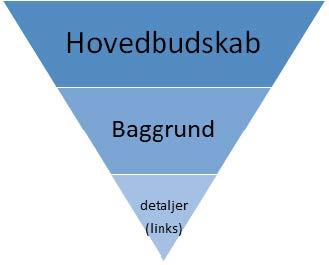
- We start our texts with the information that’s most important for the reader. For example, if the text is about something that has consequences for students, you should put the consequences first.
- Then you can add background explanations and details.
- If you need to provide more information about legal precedent (acts and ministerial orders), you should put all of this in a separate section at the end of your text (for example, under the heading ‘Legal framework’).
2. We divide our texts into paragraphs – with one main idea in each paragraph
2. We divide our texts into paragraphs – with one main idea in each paragraph
You’ll often need to use more paragraphs than you might think. Remember that your text will probably be read online – where readers tend to skim, hopping from one paragraph to the beginning of the next.
| DO | DON'T |
|---|---|
You use up an exam attempt if:
You’ll automatically be registered for your second or third exam attempt. You can’t withdraw your registration for the Master’s thesis. If you don’t turn in your Master’s thesis on time, your new exam attempt 14 days after the deadline for your previous attempt. | You use up an exam attempt if:
|
3. We use bulleted lists – but only 1) 2) 3) and •
3. We use bulleted lists – but only 1) 2) 3) and •
| DO | DON'T |
|---|---|
When you apply, remember to send us all of these things:
| Your application must be accompanied by the completed application form, a complete doctor’s certificate and transcripts from previously passed exams. |
4. We write long headers – and subheadings
4. We write long headers – and subheadings
We begin letters, emails and web texts with a header/subject line that states the main message.
We divide the rest of the text into manageable subsections with subheadings marked in bold. Each subsection should explain what the subsection is about.
And we write long headings that are self-explanatory. For example:
✕ Dispensation
✕ Exam dispensations
✓ How to apply for a dispensation if you need extra time for your exam
A good formula for writing user-friendly headings is active verb + payoff/value:
✕ Student welfare counselling
✕ Talk to a student welfare counsellor
✓ Talk to a student welfare counsellor and beat your exam stress
5. We use short sentences
5. We use short sentences
We use short sentences and simple words. This makes our texts easier to understand for everyone. This is particularly important to keep in mind when you are writing for an international audience.
Readability tests (like the Lix index) can help you make sure you’re keeping your texts simple and direct. Such tests estimate how readable texts are based on average sentence length and word length and complexity. Unfortunately, you can’t use the Lix index on English texts. One well-established readability test you can use for English texts is Flesch Reading Ease. The test ranks texts on a scale of 1-100. 100 is the most readable (easiest). You should aim for a Flesch Reading Ease score of between 60 and 80, ideally closest to the lower end of this range (reading age of about 12).
Learn more about Flesch Reading Ease
There is a great readability checker in Microsoft Word that automatically calculates a Flesch Reading Ease score.
Find out how to calculate a Flesch Reading Ease score in Word.
| DO | DON'T |
|---|---|
We will look at your case again when we receive your appeal. You will hear from us within four weeks. You can switch to a different programme or be admitted as a transfer student even if you have not passed the equivalent of the first year of study. But only if there are exceptional circumstances for you. | Upon receipt of your complaint, we will re-evaluate the case and you will receive notification from us within four weeks regarding the outcome of the re-evaluation. In the event of extraordinary circumstances, AU may permit change of degree programme or transfer admission in cases in which the applicant has not passed degree programme elements corresponding to the first year of study. Reading ease score 26.2 |
6. We can highlight keywords and deadlines
6. We can highlight keywords and deadlines
Highlighting the most important keywords and deadlines in bold can help guide your reader.
However, don’t overdo it: as a general rule, we keep things clean and professional, and we don’t use CAPITALS, yellow highlights or red lettering.
7. We use links – with precision and care
7. We use links – with precision and care
Links can be used to point students in the direction of relevant extra information that they can read if it’s relevant. But links only help you reader if you use them with care. This is how to use links:
- Write active, precise and action-oriented link texts (use words like check, see, order, find out...)
- Don’t use vague link texts like ‘Read more here’. Make link texts descriptive and meaningful, and make sure your text makes the destination of the link clear.
- Don’t ‘hide’ links in your text by using single-word links or embedding them in a sentence. Separate them from the main body of the text and put them where they’re easy to spot.
| DO | DON'T |
|---|---|
| Get checklists to help you plan your exchange Read all about your new programme in the guide for new students (pdf) Check the examination schedule for the BSc in medicine (pdf) | You can find checklists to help you plan your exchange here Read all about your new programme in this handbook for new students. Click here to read more. |