Flow and LAF-benches
A flow bench and an LAF bench are basically two words for the same equipment (Laminar Air Flow).
However, a distinction is made in the legislation depending on whether the bench only protects the product or whether it also protects the user from hazardous substances.
It is important to remember that a flow bench or an LAF bench is only safe when it is properly installed, tested, and used correctly.
What is a flow bench?
What is a flow bench?
A flow bench is also called a sterile bench or Clean Bench.
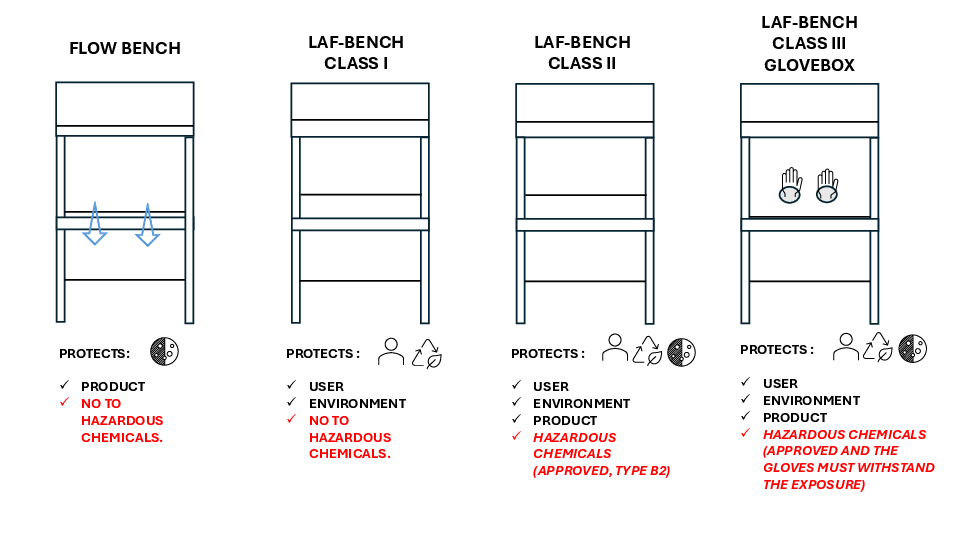
Function: Blows sterile, HEPA-filtered air across the work area to keep your samples free of dust and bacteria. Primarily used for harmless work (cultivation of harmless organisms or sterile packaging).
Protection: Protects the product/workpiece ONLY. It does not protect you as an user.
Installation: Flow benches/Sterile benches generally do not require extensive installation. These enclosures take room air and filter it through a HEPA filter to achieve the desired product protection.
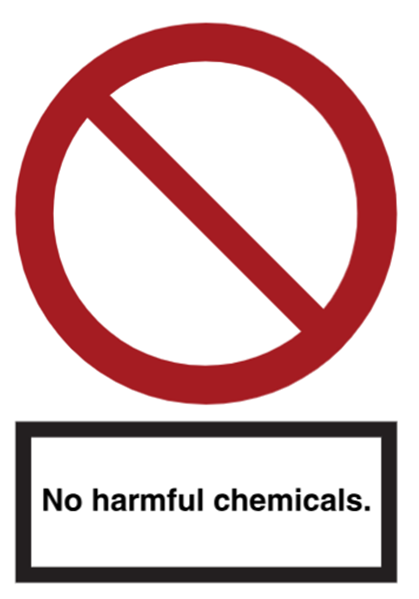
Important: It is NOT possible to work with hazardous chemicals in a flow bench! It is recommended that a prohibitory sign be affixed against the handling of hazardous chemicals.
What is a LAF-bench?
What is a LAF-bench?
An LAF bench, also called a safety cabinet, is available in three classes depending on the work that will take place in the safety cabinet.
Function: An advanced bench with a controlled airflow, where the air is often sucked away from the user and filtered before it is either recirculated or discharged out of the building, depending on the class.
Pootection: Depending on the class of the safety cabinet:
- Classe I protects the user and the surroundings -used for e.g. weighing powder and in case of risk of dust formation - Not suitable for hazardous chemicals.
- Class II protects both user, environment and product - used for e.g. microbiological work and medication management. Class II is the most common to use for research and development.
- Class III provides maximum protection and is used for infectious microorganisms.
Installation: In connection with installations in Denmark, you must comply with the Danish Working Environment Authority's local requirements for the laboratory. Most installations will typically require the cabinet to be connected to a ventilation system.
A safety cabinet must have at least a certificate, EN12469 or DIN 12980 and any additional requirements in relation to function.
Training and Instruction
Training and Instruction
Safety in a Flow bench or a LAF bench cannot be ensured by technology alone – it also requires qualified use of it, so that the behavior you have in and around the bench does not jeopardize safety.
Training and instruction must be provided in the correct use of a flow bench or a LAF bench, including proper cleaning and disinfection after work is completed.
There are various suppliers that offer courses in:
- LAF Driver's License course, where you learn to work correctly in an LAF bench.
- LAF Manager course, where you get a deeper insight into LAF benches and learn about the practical conditions, such as daily use, testing and correct placement.
Can you work safely with hazardous chemicals in an LAF bench?
Can you work safely with hazardous chemicals in an LAF bench?
It depends on the type of LAF bench.
Use the biological and chemical risk assessment to evaluate which facilities/equipment are needed in the work process.
There are many factors that determine the choice of facility/equipment, such as:
- Is it powder or a solution that needs to be handled?
- What quantities - is it 1 μL or 1 liter?
- Is it irritating to inhale or irritating to the skin?
- Is it allergic in contact with the skin and/or if inhaled?
- Is it toxic if inhaled? Toxic if ingested? Toxic in contact with skin?
- Carcinogenic? Reproduction toxic?
- How is the work done?
Examples:
- Sterile work may be required in an LAF bench where small amounts of hazardous chemicals, such as skin irritants, are handled. Here, a class I and II can be used if the employee is wearing gloves.
- An EDTA solution is used, which, over 10% is classified and labelled with H319 Causes serious eye irritation and H373 May cause damage through prolonged or repeated exposure, should be handled in fumehooh.
However, by producing solution below 10%, it is no longer hazardous and can be handled in the LAF-bench. - Medication must be used. Instead of making a solution yourself, it is bought ready-made. It is in a 5 mL ampule and 1 μL must be pipetted in 96 wells.
The risk of exposure by weighing is eliminated by purchasing a ready-made solution. The risk of exposure to inhalation from evaporation is reduced to a minimum by having a small container with a very small evaporation surface, which is handled in the LAF-bench that is connected to the ventilation. From here, it is pipetted to a well, where it is further diluted. Each well in turn has a small surface area for evaporation. The titer tray is covered with a lid at the end. - Preparation of 2.5% antibiotic solution, which is classified as suspected reproduction toxic. Prepared in a well-functioning fumehood, then sterile filtered in the biological laboratory. The solution is now below the limit for suspected reproductive toxicity, which is 3%, and can therefore be safely handled in the LAF-bench.
- There may be a need to fix tissue with formalin, where the sterile element is no longer important, here the requirement for a facility will be a closed system (well-functioning fume cupboard), as formalin is a §19 substance.
- There may be a need to handle cytostatics, here a special LAF bench is required, a BSC class II - type B2, which can handle hazardous chemicals and keep the area sterile - there must be established 100% extraction from the bench and there must be no recirculation of the ventilation.
Difference between LAF bench class II and a well-functioning fumehood
Difference between LAF bench class II and a well-functioning fumehood
| Protection | Class II LAF-bench | Fumehood(well-functioning) |
| User | YES | YES |
| Environment | YES (HEPA) | NO (polution is diluted in the air) |
| Product | YES | NO |
| Handling biological material category II. | YES | NO |
| Handling organic solvents | NO (HEPA is destroyed) | YES |
| Handling hazardous chemicals | MAYBE -depending on the bench, requires 100% exhaust and no recirculation of ventilation - BSC class II - type B2. But also depening on volumes, types of hazardous properties - use the risk assesment. | YES |
| Handling carcinogenic chemicals, including §19 substances ( closed system) | MAYBE, (BSC class II - type B2) requires a certificate of trace gas measurement. | MAYBE, (BSC class II - type B2) requires a certificate of trace gas measurement. |
Procurement, certification and service
Procurement, certification and service
Seek advice.
Good advice is important, because it does matter which bench you choose for the job.
Type of bench, number of filters, size and ventilation, as well as the right location are crucial factors that come into play. Therefore, always use qualified advice - there are a number of qualified suppliers in the laboratory market.
If it is a question of several benches or an entire rebuilding of the laboratory, professional project management should be considered.
Only for LAF-bench.
Certificate - LAF-bench.
According to DS/EN 12469, LAF benches must be tested for a number of requirements. Tests on the electrical installations, airflow, flow visualization, ease of cleaning, acoustic alarms and much more.
Upon meeting the described requirements, a certificate is issued and affixed to the LAF bench.
When you are in the market for a new LAF bench, it is important to pay attention to wording such as "Manufactured according to EN12469" or "The bench meets EN12469", which are often used in place of specific certificate information.Service.
LAF benches must be serviced once a year by a certified technician using calibrated equipment.
The purpose is to ensure that the HEPA filter works, the air speed is correct and that the working environment remains sterile for both user and product.
Service takes place according to DS/EN12469, if the bench meets the requirements a valid certificate is issued, which is attached to the bench.
"Save energy"
"Save energy"
There are several popular benches that belong to an older technical generation, but are still used in many laboratories.
An older LAF bench uses more than five times as much energy as a similar new bench. This is partly due to the fact that the fans in the new benches are far more efficient than the previous traditional fans.
- 1.2 cabinet with AC motor consumes approx. 600 watts/hour.
- 1.2 cabinet with EC motor consumes approx. 2-300 watts/hour - a saving of 3-400 watts/hour
Other energy-saving factors:
- LED lights inside the bench and
- PIR sensor that automatically puts the bench into "ECO mode" when not working inside the bench. In ECO mode, the bench consumes only 40-80 watts/hour.
Calculation of the energy consumption for a bench:
Most suppliers offer a way of being able to calculate the energy consumption if there is a need for documentation of this for e.g. LEAF.